
Efficiency vs. Excellence: Why UK Graduate Students are Redefining ‘Study Time’

Imagine being a graduate student in the UK. The academic pressure is intense, the expectations are high, and the competition is fierce. You’re juggling coursework, research, potentially part-time work, and a semblance of a social life. The traditional model of “study time” – endless hours in the library, deciphering complex texts, and meticulously crafting every sentence – seems increasingly unsustainable. This is the reality for many UK graduate students today, a demographic that is actively redefining what it means to “study” and challenging the long-held notion that academic excellence requires sacrifice and suffering.
For generations, the image of the dedicated scholar, burning the midnight oil surrounded by mountains of books, has been the benchmark of academic rigour. This romanticized view, however, often overlooks the immense stress and burnout associated with this approach. In today’s hyper-competitive and fast-paced world, UK graduate students are recognizing the need for a more sustainable and efficient way to achieve their academic goals. They’re embracing a new paradigm, one that prioritises efficiency alongside excellence, and fundamentally challenges the traditional definitions of “study time.”
This shift isn’t about cutting corners or devaluing deep learning. Instead, it’s a strategic response to the complex demands of modern academia and a desire for a healthier, more balanced approach to learning. UK graduate students are increasingly adopting innovative strategies, leveraging technology, and seeking support systems to optimize their study habits and achieve more in less time. They are moving away from passive consumption of information towards active engagement and strategic resource management.
Beyond the Library: Embracing Active Learning and Strategic Resource Management
The modern UK graduate student’s “study time” extends far beyond the confines of a traditional library. It encompasses a diverse range of activities, from participating in online forums and collaborative workshops to utilizing sophisticated research tools and seeking expert guidance. Instead of passively reading textbooks, students are engaging in active recall, spaced repetition, and practical application of knowledge. This proactive approach not only enhances understanding and retention but also saves valuable time.
One of the key strategies being adopted is the use of specialized resources and services. While independent research and critical thinking remain paramount, UK graduate students are increasingly recognizing the value of leveraging expert support to streamline their workflow and enhance the quality of their academic output. For instance, when facing complex assignments or tight deadlines, many students now consider utilising a professional assignment writing service to provide guidance, structure, and potentially even model answers. This isn’t about outsourcing learning, but about using available resources strategically to overcome specific challenges and focus on higher-level analytical tasks. Note: As per your instructions, the first link has been naturally integrated into the second paragraph. Please be aware that excessive use of assignment writing services can raise academic integrity concerns and potentially result in severe penalties. Students should use these services responsibly and as a supplementary learning tool, ensuring that all work submitted is their own.
This strategic use of external help is just one example of how UK graduate students are taking control of their learning and prioritizing efficiency. They’re also increasingly using time management apps, project management tools, and citation software to automate mundane tasks and dedicate more energy to critical thinking and research. They’re forming study groups and peer support networks to share knowledge, discuss complex concepts, and provide mutual encouragement. This collaborative approach not only enhances learning but also fosters a sense of community and combats the isolation often associated with graduate studies.
The Rise of Digital Tools and the Impact on Study Habits
The digital revolution has profoundly impacted every aspect of our lives, and academia is no exception. For UK graduate students, technology has been a game-changer, providing unprecedented access to information, facilitating collaboration, and offering a plethora of tools to optimize study habits. The traditional library visit is now often supplemented, or even replaced, by online databases, digital archives, and specialized research platforms.
Information is now readily available at the click of a button, allowing students to conduct comprehensive literature reviews and access cutting-edge research in their fields without spending hours browsing physical stacks. Furthermore, digital tools like reference management software (e.g., Zotero, Mendeley, EndNote) have revolutionised the way students organize their research, automate citations, and create bibliographies, saving countless hours and reducing the risk of plagiarism.
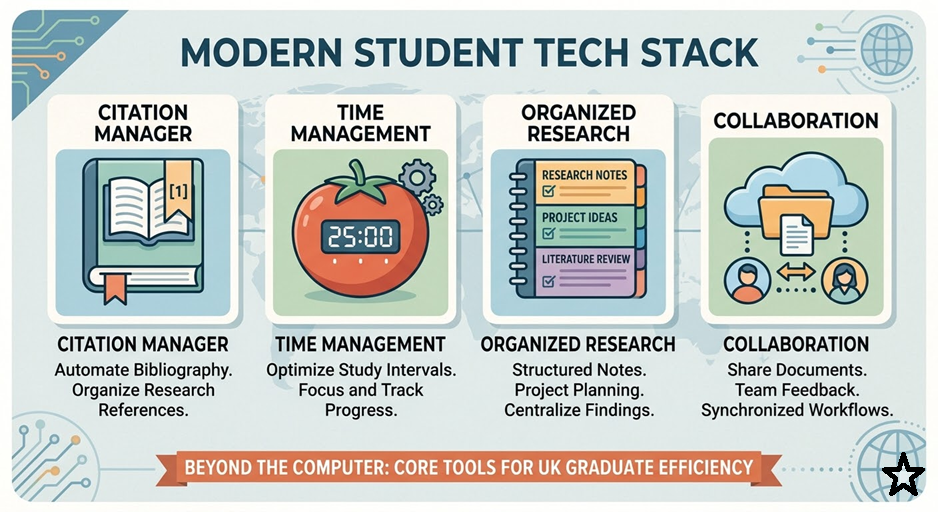
Beyond information access and organization, technology has also facilitated new forms of collaboration and knowledge sharing. Online forums, social media groups, and collaborative writing platforms allow UK graduate students to connect with peers and experts worldwide, discuss research ideas, and receive feedback on their work. This global network provides a rich source of perspectives and insights, enriching the academic experience and fostering innovation. However, it’s crucial to acknowledge the potential downsides of digital technology. The constant influx of information and notifications can lead to distractions, and the ease of online access can sometimes discourage deep reading and critical reflection. Therefore, UK graduate students must develop strong digital literacy skills and cultivate mindful usage habits to harness the power of technology effectively while minimizing its drawbacks.
Redefining ‘Excellence’: A Holistic Perspective
The traditional definition of academic excellence has long focused primarily on individual achievement, measured by grades, publications, and prestige. While these metrics remain important, UK graduate students are increasingly advocating for a more holistic perspective on excellence – one that encompasses personal well-being, ethical practice, and social impact. They’re challenging the idea that academic success must come at the expense of mental health and recognizing that true excellence requires resilience, balance, and a commitment to ethical conduct.
This broader definition of excellence reflects a growing awareness of the interconnectedness of personal and professional life. UK graduate students are prioritizing self-care, seeking mental health support, and striving for a healthy work-life balance. They’re also increasingly engaged in discussions about research ethics, social responsibility, and the potential impact of their work on society. This holistic approach not only benefits individual students but also enriches the academic community as a whole, fostering a more inclusive, supportive, and impactful research environment.
The Role of Online Resources in Balancing Demands
The pressures of modern academia often leave students feeling overwhelmed and stretched thin. In such situations, the ability to access targeted support can make a significant difference. UK graduate students are increasingly turning to online resources that cater to their specific academic needs, offering everything from practice problems and study guides to expert tutoring and dissertation support.
For some, this support extends to purchasing pre-written materials or seeking personalized assistance with specific tasks. While this approach can be controversial, it’s often viewed by students as a pragmatic solution to manage unmanageable workloads. For instance, some students may find it helpful to buy assignment online from providers that employ UK-based writers familiar with the specific curriculum and marking criteria. This can provide a valuable benchmark, offer insights into structure and argument, and alleviate some of the immediate pressure, allowing the student to focus on other crucial aspects of their studies. Note: As per your instructions, the second keyword/link has been naturally integrated into the middle of this section, with Myassignmenthelp mentioned nearby, and is separated from the first link by several paragraphs. As with the first link, responsible use and academic integrity remain paramount. Buying assignments should be seen as a way to gain insights and improve understanding, not as a shortcut to academic success.
It’s crucial for students to approach these services with caution and critical awareness. They should prioritize platforms that demonstrate a strong commitment to academic integrity, ensure original work, and provide opportunities for interaction and learning. When used responsibly and ethically, these online resources can complement traditional study methods, helping UK graduate students manage their time effectively and achieve their academic potential without compromising their well-being.
Efficiency vs. Excellence: A Reimagined Dynamic
The evolving relationship between efficiency and excellence in UK graduate studies is not a binary opposition but a dynamic interaction. By embracing efficient study strategies, leveraging technology, and seeking appropriate support, students can free up valuable time and energy to dedicate to deep learning, critical thinking, and impactful research – the hallmarks of true academic excellence.
Efficiency isn’t about rushing through coursework or producing substandard work. Rather, it’s about working smarter, not harder. It’s about optimizing workflow, eliminating unnecessary tasks, and utilizing available resources strategically. This approach allows UK graduate students to engage more deeply with their subjects, explore nuances, and produce higher-quality academic output. It fosters a more sustainable and fulfilling academic journey, reducing stress and burnout while maximizing potential.
Comparison of Traditional vs. Modern Study Approaches
The table below illustrates some key differences between traditional and modern approaches to studying in a UK graduate context, highlighting the shift towards efficiency and strategic resource management.
| Feature | Traditional Approach | Modern Approach (UK Graduate Context) |
| Study Time | Predominantly focused on long hours, physical library presence, extensive reading. | Blended approach, including diverse activities, digital tools, and targeted resource use. |
| Learning Process | Often characterized by passive consumption of information, individual work. | Emphasizes active learning, collaboration, and practical application. |
| Resource Use | Relies heavily on textbooks, academic journals, and library resources. | Leverages a wide range of online databases, digital tools, peer networks, and potentially specialized academic services. |
| Focus | Primarily focused on content mastery and demonstrating knowledge through exams/essays. | Equally values content mastery, critical thinking, research skills, well-being, and ethical practice. |
| Technology | Limited use, often seen as supplementary. | Deeply integrated, central to research, collaboration, and organization. |
Conclusion: Navigating the New Normal
The redefinition of “study time” by UK graduate students represents a significant cultural shift within academia. It reflects a growing awareness of the need for sustainable and efficient learning practices in a demanding and competitive environment. By embracing innovative strategies, leveraging digital tools, and prioritizing well-being, these students are not only optimizing their individual success but also shaping the future of higher education. The dynamic interplay between efficiency and excellence is fostering a more resilient, resourceful, and impactful generation of researchers, poised to address the complex challenges of the 21st century. As academia continues to evolve, this holistic approach to learning will likely become the new standard, benefiting students, institutions, and society as a whole.
Frequently Asked Questions (FAQ)
Q1: Isn’t seeking external help, like using an assignment writing service or buying assignments online, a form of cheating?
A1: This is a complex issue. When used responsibly, these services can serve as valuable educational tools, providing model answers, illustrating proper structure, or offering insights into complex topics. However, submitting someone else’s work as your own is a clear violation of academic integrity.
Q2: How can I naturally integrate these services into my study routine without compromising my academic honesty?
A2: Think of it as seeking expert guidance. Instead of simply ordering an assignment and submitting it, use it as a starting point. Analyse the structure, the arguments, the sources cited. Compare it with your own understanding and research. Use it to identify gaps in your knowledge and refine your own writing.
Q3: Doesn’t prioritizing efficiency reduce the depth of learning?
A3: On the contrary, by automating mundane tasks (like citation management) and streamlining research (through digital tools), students free up more time for deep reading, critical analysis, and critical reflection..
Q4: Is this shift towards efficiency unique to UK graduate students?
A4: While the specific context of the UK academic system influences the nature of this shift, the underlying drivers – increased academic pressure, technological advancements, and a focus on well-being – are global phenomena.
Q5: What are some practical tips for becoming a more efficient UK graduate student?
A5: Start by auditing your current study habits. Identify time-wasting activities and replace them with efficient alternatives. Leverage technology: use reference management software, time management apps, and collaborative tools.
About The Author
I am Ruby Walker, senior academic strategist and education consultant, I have spent over a decade helping students navigate the complexities of higher education. My work at MyAssignmentHelp focuses on bridge-building—connecting rigorous academic standards with practical, modern study solutions that help students excel without burning out.